
| Connection | What you provide |
|---|---|
| Codex · default | Native Codex CLI and its ChatGPT sign-in. This integration does not require an OpenAI API key. |
| GitHub Copilot | Native Copilot CLI and its own sign-in flow; separate from source-control authentication. |
| OpenAI API, Claude, Gemini and other APIs | The selected provider's credentials and account. Service usage and billing remain with that provider. |
| Ollama or LM Studio | A separately installed local server and a model that supports the required operations. |
| Custom, Azure OpenAI or Amazon Bedrock | Endpoint, supported authentication and explicit model identifiers as described in the provider reference. |
Configure the connection in settings
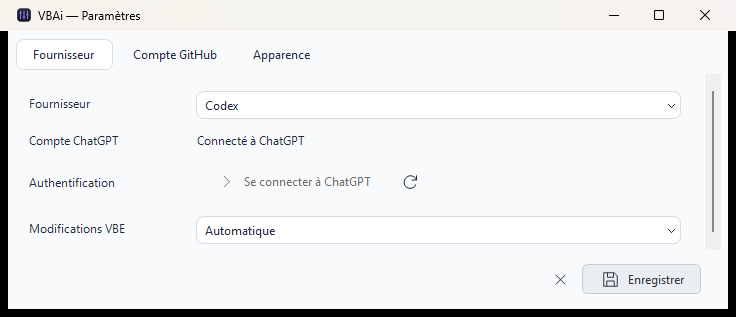
Choose the provider in VBAi settings. The relevant authentication and endpoint controls depend on that choice. Saved keys are protected with Windows DPAPI for the current user.
Codex and Copilot use isolated VBAi provider directories. Being signed in through another application's CLI directory does not establish this connection automatically.
Choose the model in the conversation
Select a model and any supported reasoning effort in the chat. Available choices depend on the provider catalog; custom, Azure and Bedrock connections use configured identifiers.
A listed model may not support tools. Start with an explanation and a harmless inspection before asking it to change the project. Local quality, latency and tool support depend on your model and server.
Detailed transport and model limitsUnderstand cost and data boundaries
The add-in is open source, but it does not supply an AI subscription, API credits or a usage entitlement. A provider may charge for the account or requests you use.
Remote providers receive the conversation and permitted context. Local storage and provider-side retention are separate concerns. Choose the context deliberately, and follow your organisation's rules before sharing professional code.
Read the privacy guide